Understanding plant-environment interactions via biomolecular condensation
Hosted by Dr Shen Lisha
- Details
- Date & TimeDecember 12, 2025
- VenueAuditorium Level 1
- FeesFree
- PAX Limit30
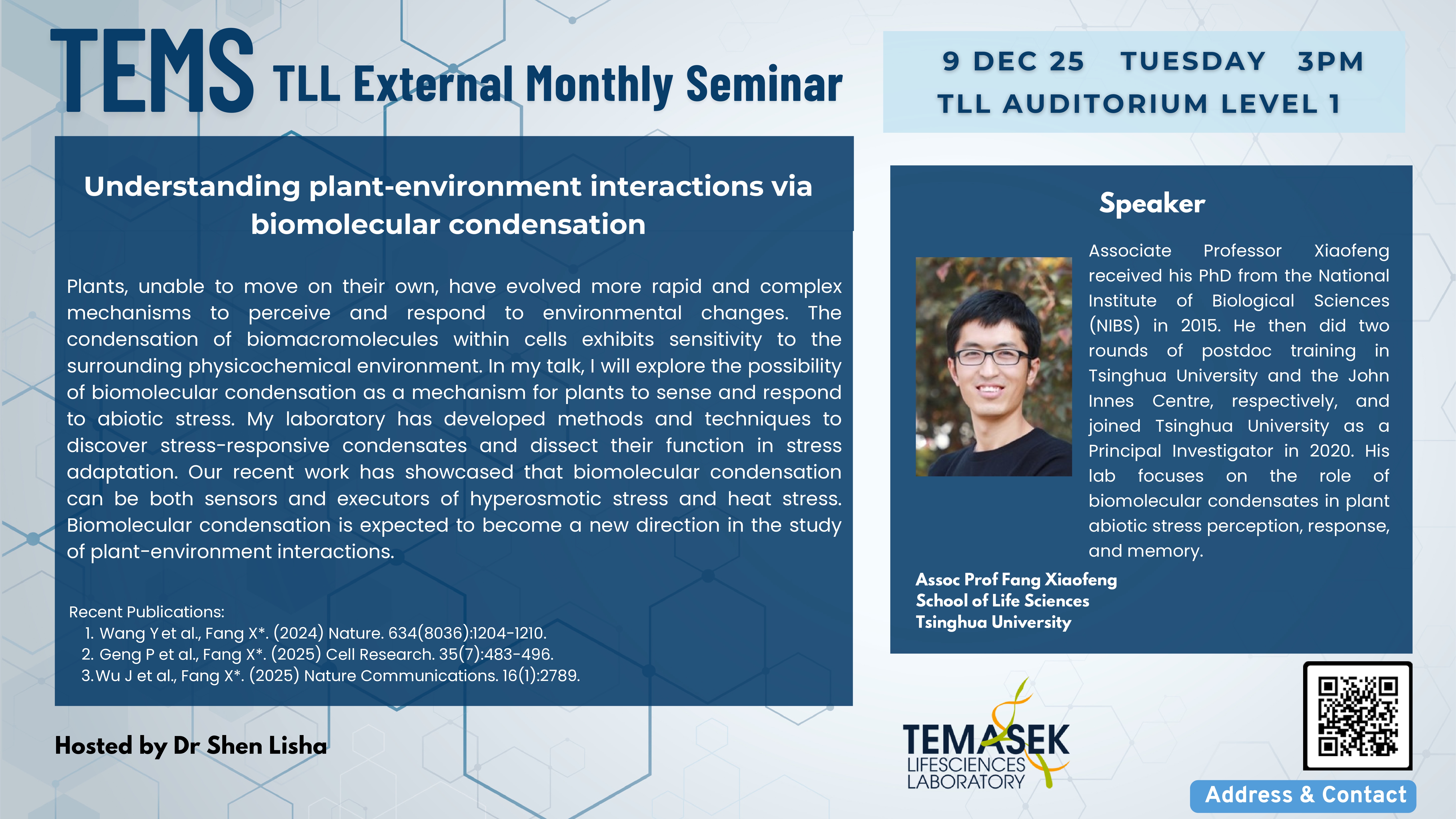
Plants, unable to move on their own, have evolved more rapid and complex mechanisms to perceive and respond to environmental changes. The condensation of biomacromolecules within cells exhibits sensitivity to the surrounding physicochemical environment. In my talk, I will explore the possibility of biomolecular condensation as a mechanism for plants to sense and respond to abiotic stress. My laboratory has developed methods and techniques to discover stress-responsive condensates and dissect their function in stress adaptation. Our recent work has showcased that biomolecular condensation can be both sensors and executors of hyperosmotic stress and heat stress. Biomolecular condensation is expected to become a new direction in the study of plant-environment interactions.
Recent Publications:
- Wang Y et al., Fang X*. (2024) Nature. 634(8036):1204-1210.
- Geng P et al., Fang X*. (2025) Cell Research. 35(7):483-496.
- Wu J et al., Fang X*. (2025) Nature Communications. 16(1):2789.
Speaker
Associate Professor Xiaofeng Fang received his PhD from the National Institute of Biological Sciences (NIBS) in 2015. He then did two rounds of postdoc training in Tsinghua University and the John Innes Centre, respectively, and joined Tsinghua University as a Principal Investigator in 2020. His lab focuses on the role of biomolecular condensates in plant abiotic stress perception, response, and memory.
Assoc Prof Fang Xiaofeng
School of Life Sciences
Tsinghua University